The October edition of the Oeconomus Economic Club was held under the title “Governments Come and Go, but Retail Remains.” The event, conducted under the Chatham House Rule, placed particular emphasis on the situation of independent petrol stations and the advertising market, both of which are facing serious challenges. The presentations and discussions highlighted that retail plays a crucial role in the national economy. However, despite earlier promises, the change of government has so far failed to resolve the sector’s mounting problems.
Old Challenges, New Problems
“Since the coronavirus pandemic, the sector has faced continuous difficulties, ranging from fuel price caps and protected prices to mandatory profit margin caps and special taxes. Although consumption has shown some growth, the situation remains uncertain,” said Péter Törcsi, opening the October edition of the Oeconomus Economic Club, which focused on the state of the retail sector.
The President of the Oeconomus Economic Research Foundation pointed out that the topic was particularly timely, as two new measures could once again disrupt the sector: changes to the KATA small business tax scheme and the introduction of a wealth tax.
“The wealth tax could affect a large number of small and medium-sized enterprises, whose company value, assets or even turnover could reach the HUF 1 billion threshold. The question, however, is whether they will be able to generate enough profit to cover the new tax,” he said, posing the opening question to the invited experts.
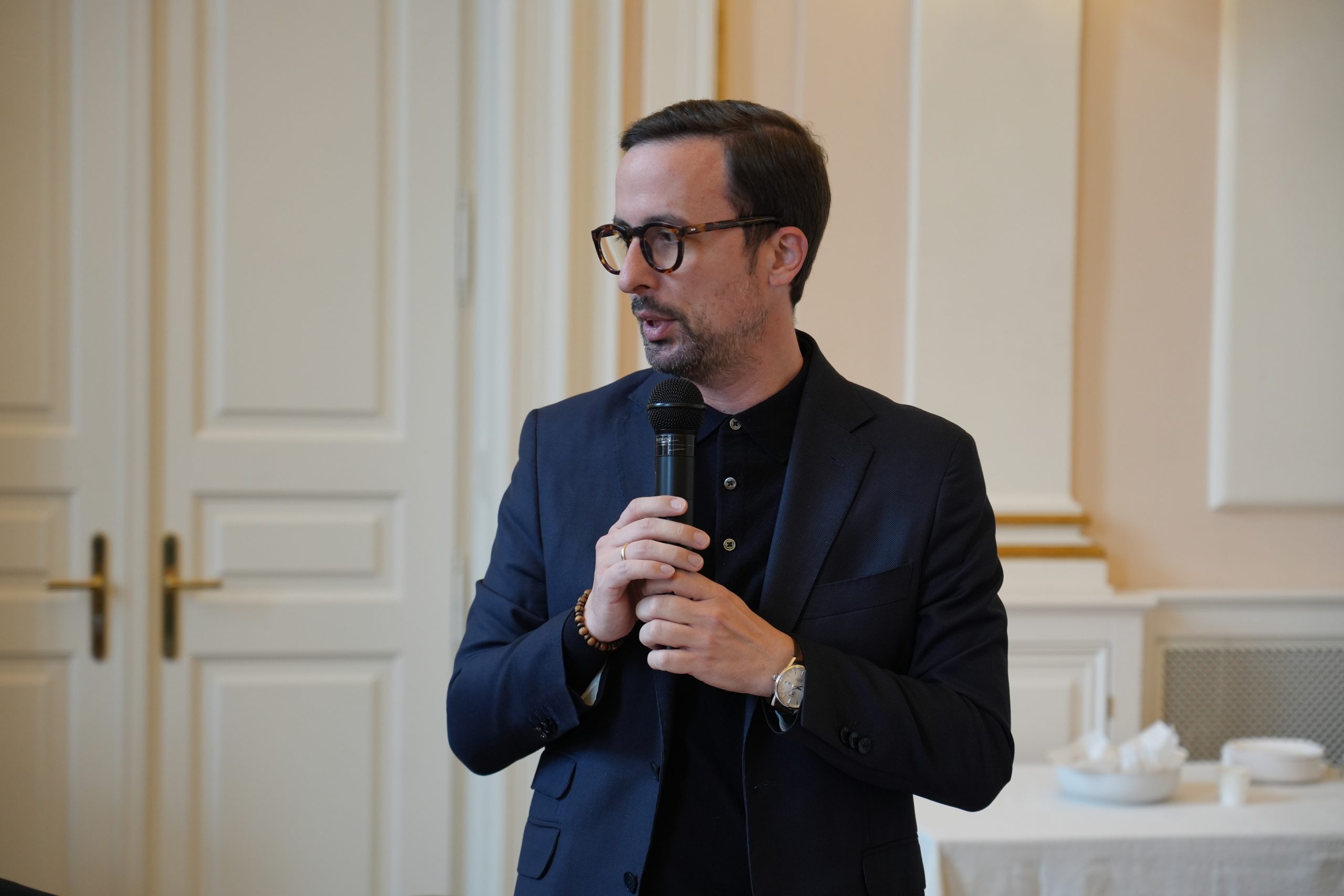
Opening remarks by Péter Törcsi, President of the Oeconomus Economic Research Foundation
Independent Petrol Stations Struggle to Survive
In recent years, petrol stations have been among the sectors most exposed to changes in the geopolitical environment and domestic regulations.
“By now, the possibility of fraud has been virtually eliminated. This is one of the most transparent and compliant segments of the retail sector. According to surveys by the National Tax and Customs Administration (NAV), 98 percent of fines imposed on the sector result from administrative errors,” said a speaker familiar with the situation of independent petrol stations, providing some historical context.
The expert warned that the sector has faced continuous challenges since 2020–2021. In his view, even the initial introduction of the fuel price cap was poorly thought out, as it failed to anticipate that wholesale prices would soon exceed retail prices.
He recalled that the system was unsustainable, although the sector managed to secure some compensation for its losses from the previous government.
“This was enough to keep independent petrol stations alive. However, it did not allow them to develop or expand,” he explained, highlighting the shortcomings of the measures.
He added that the temporary removal of the fuel price cap provided only brief relief for independent petrol stations, while its reintroduction in March had a devastating impact.
The expert explained that the authorities had attempted to mitigate the effects by releasing strategic reserves purchased at lower prices, but this approach presented several problems. Replenishing the reserves would cost the country more, the reserves were eventually depleted, and the measure came nowhere near covering the losses.
The speaker acknowledged that hopes associated with the change of government had proved unfounded. The new government had turned the previous administration’s decree-based regulations into legislation, while the enormous tax burden on the sector, 20 times higher than that imposed on other industries, had not been reduced.
Furthermore, under the Energy Efficiency Obligation Scheme (EKR), solar panel systems installed at petrol stations and efficiency-enhancing additives blended into fuels still cannot be counted towards energy efficiency obligations.
“The new government said one thing in March, says something different now, and who knows what it will say in the future. There is no reliable policy, no predictable regulatory framework, only a constant struggle to survive,” he concluded pessimistically.
Responding to questions raised during the discussion, the expert proposed several possible solutions, including more rational fuel consumption, targeted support for those in need, and a reduction in excessive tax burdens.
Criticising the proposed wealth tax, he stressed that the issue was particularly serious for independent petrol stations.
“No one will invest in development or increase the value of their assets. The decision is fundamentally misguided,” he warned.

Contribution by Mátyás Gondi, Vice President of the Oeconomus Economic Research Foundation
Advertising Market Faces Serious Challenges
“Every forint invested in the advertising industry generates six forints in returns for the national economy. In 2025, HUF 760 billion was spent on communications targeting Hungarian consumers,” said a speaker with extensive knowledge of the industry, illustrating the economic importance of advertising.
Reviewing market developments in recent years, the expert explained that the sector is highly sensitive to economic changes. Overall, the market has contracted in real terms over the past few years and has still not returned to its pre-pandemic level.
Moreover, the structure of the market has changed significantly, with global media companies accounting for an increasing share. While their share was below 5 percent in 2010, it is expected to approach 40 percent this year.
This presents a serious challenge, as more than a third of advertising expenditure now flows to these global players. The question is how local media companies will be able to finance their operations when advertising still accounts for nearly 60 percent of their revenues.
To make matters worse, the expert noted that the advertising market had been artificially inflated in recent years, partly due to government advertising contracts, a situation that is certain not to continue.
“The changes to outdoor advertising regulations were a painful surprise for us as well. Essentially, the number of outdoor advertising spaces will be drastically reduced. Between 90 and 95 percent of billboards will disappear,” he explained.
According to the expert, while ordinary citizens might even welcome this development, it will have serious consequences for the industry.
“It is virtually certain that many companies will go bankrupt and jobs will be lost,” he warned.
“The dead cannot dig their own graves. Companies that have gone bankrupt will no longer be able to remove billboard structures that have become illegal,” he said, highlighting another consequence of the new regulations.
He also pointed out that the value of the remaining advertising spaces is likely to increase, potentially making them unaffordable for smaller advertisers.
As a result, local advertising campaigns, such as those previously run by neighbourhood bakeries, theatres or civil society organisations, may become unviable.
The industry expects that much of this advertising expenditure will shift towards digital platforms, where a significant proportion of the money will flow to global companies. From the perspective of the national economy, this would be an unfavourable development.
The expert added, however, that the new situation could also create opportunities for certain small and medium-sized enterprises that own media outlets.
A Vital Sector Facing a Downturn
In her contribution, Viktória Németh recalled that consumption had been the main driver of GDP growth in 2026. Household consumption increased by 5.5 percent in the first quarter and 4.5 percent in the second quarter, supported by strong wage growth.
“Although retail sales also grew dynamically, expanding by 4.3 percent between January and August 2026, an unfavourable trend has emerged since April 2026.
During this period, retail sales volumes declined month on month on three occasions: in April, June and August. Moreover, in August, year-on-year growth slowed to just 2.4 percent,” she said, citing the latest available statistics.
The Senior Analyst at the Oeconomus Economic Research Foundation warned that Hungary’s retail sector is shaped by both domestic and international trends.
Online retail, for example, is growing by an average of 12 percent annually.
“An unfavourable trend, however, is that nearly a quarter of products purchased online were imports from Asian, primarily Chinese, multinational giants,” she explained.

Viktória Németh, Senior Analyst at the Oeconomus Economic Research Foundation
Németh also pointed out that retail is one of Hungary’s largest employers, providing jobs for approximately 310,000 people, equivalent to 6.6 percent of the country’s workforce.
“Small and medium-sized enterprises account for 99 percent of companies operating in the sector and employ more than 60 percent of its workforce. Large retail chains account for just over a third of employment, while average earnings are around the national median wage, or HUF 611,400 gross per month,” she said, outlining the sector’s labour market characteristics.
Among the sector’s most significant challenges, she highlighted the level of taxation and government regulation, particularly sector-specific taxes and mandatory profit margin caps.
“The changes anticipated during the preparation of the 2027 budget are creating considerable uncertainty and concern among market participants, particularly regarding the continuation of sector-specific taxes and the possible extension of profit margin caps,” she warned.
Among the regulatory challenges and proposals putting further pressure on the sector, she mentioned the risk of tax and regulatory shocks, the global minimum tax, the threat of the grey economy and the impact of the proposed wealth tax.
“The planned wealth tax could significantly weaken the financial strength of larger domestically owned retail chains with substantial property holdings and logistics centres. At the same time, smaller SMEs operating from rented premises could be indirectly disadvantaged, as the additional tax burden may be passed on to them through higher rents,” she concluded.

Foreign policy expert, journalist, press officer. He was a foreign policy journalist and editor for fourteen years, mainly at Magyar Nemzet. He specializes in the Middle East and North Africa. As a journalist, he has visited several countries and conflict zones in the region. He has reported from Israel and Palestine, Lebanon, Iraq, Turkey, Jordan, and Saudi Arabia, but he has also visited Ukraine, Nagorno-Karabak, and Cyprus.


