Two important deadlines are approaching in Iraq: by September 30, 2026, the Americans will withdraw their troops from the country, and all non-state militias must lay down their arms. The most recent U.S. withdrawal proved to be premature; the power vacuum gave rise to the Islamic State, which engulfed the region in flames and kept Europe in a state of terror with its attacks. There is no need to fear a repeat of this now, but in Iraq—which is grappling with severe economic challenges—disarming the militias and resisting Iranian influence will pose a serious challenge. Hungary was also a member of the international coalition formed to combat the Islamic State, so after eleven years, the Hungarian mission in Iraq is coming to an end.
The End of an Era
The United States and Iraq agreed back in 2024 that U.S. troops would withdraw from the country by the end of 2026. Although both countries have since elected new leaders, their commitment has remained unchanged. The Americans began their withdrawal last year and have since repeatedly confirmed that everything is proceeding according to plan and that they will fulfill their commitment by the September 30 deadline. This marks the end of an era spanning nearly a quarter-century.
Following the U.S. invasion of Iraq in 2003—a decision made by George W. Bush but carried out during Barack Obama’s presidency—U.S. forces had already withdrawn completely from the country once, in 2011. However, that move proved to be premature. The unstable Iraqi government forces were unable to stop the Islamic State, so in 2014, at Baghdad’s request, the United States returned—this time leading an international coalition and with a much smaller force. Although the terrorist organization had lost all its territory by 2017, the Americans remained to combat underground Islamist cells. Combat operations concluded by the end of 2021, after which they have been working to strengthen Iraqi government forces through training and advisory support to the present day.
The figure can be found here: https://infogram.com/number-of-us-troops-in-iraq-1hmr6g8nd1n3z2n
According to calculations by the Watson Institute, the wars in Iraq and Syria cost U.S. taxpayers at least 1,800 billion (!) dollars between 2003 and 2023. This figure does not include the costs incurred by U.S. allies. According to their estimates, when factoring in veterans’ benefits and pensions, the total could reach 2,890 billion dollars by 2050.
The Hungarian Mission Bids Farewell
Hungary also joined the international coalition formed to combat the Islamic State. Hungarian soldiers were stationed in the city of Erbil in Iraqi Kurdistan, where they carried out partner capacity-building, military assistance and advisory, as well as troop escort duties. A maximum of 20 Hungarian soldiers, rising to 40 during rotation periods, served in Iraq as part of the “ ” mission. The previous government decided last November to extend the overseas mission until December 31, 2026.
However, after the Erbil base became a target of Iranian retaliatory strikes following the war launched by the United States and Israel against Iran, Hungarian soldiers and diplomats were withdrawn on March 14, 2026, for security reasons. Since the September 30 deadline applies to bases in Kurdistan and coalition forces as well, this will likely bring the Hungarian mission to an end. The caution was, in fact, justified: according to a Pentagon report, between April and June, Iran and its allied Iraqi militias attacked Iraqi targets at least 600 times. According to the Kurdish news site Rudaw’s own calculations, at least 1,000 drones and rockets were fired at Kurdistan.
Hungary’s involvement in Iraq does not end entirely with this, however. Previously, Hungary Helps launched several projects primarily to assist Iraqi Christians. The Ecumenical Aid Organization also has several aid programs running in the country.
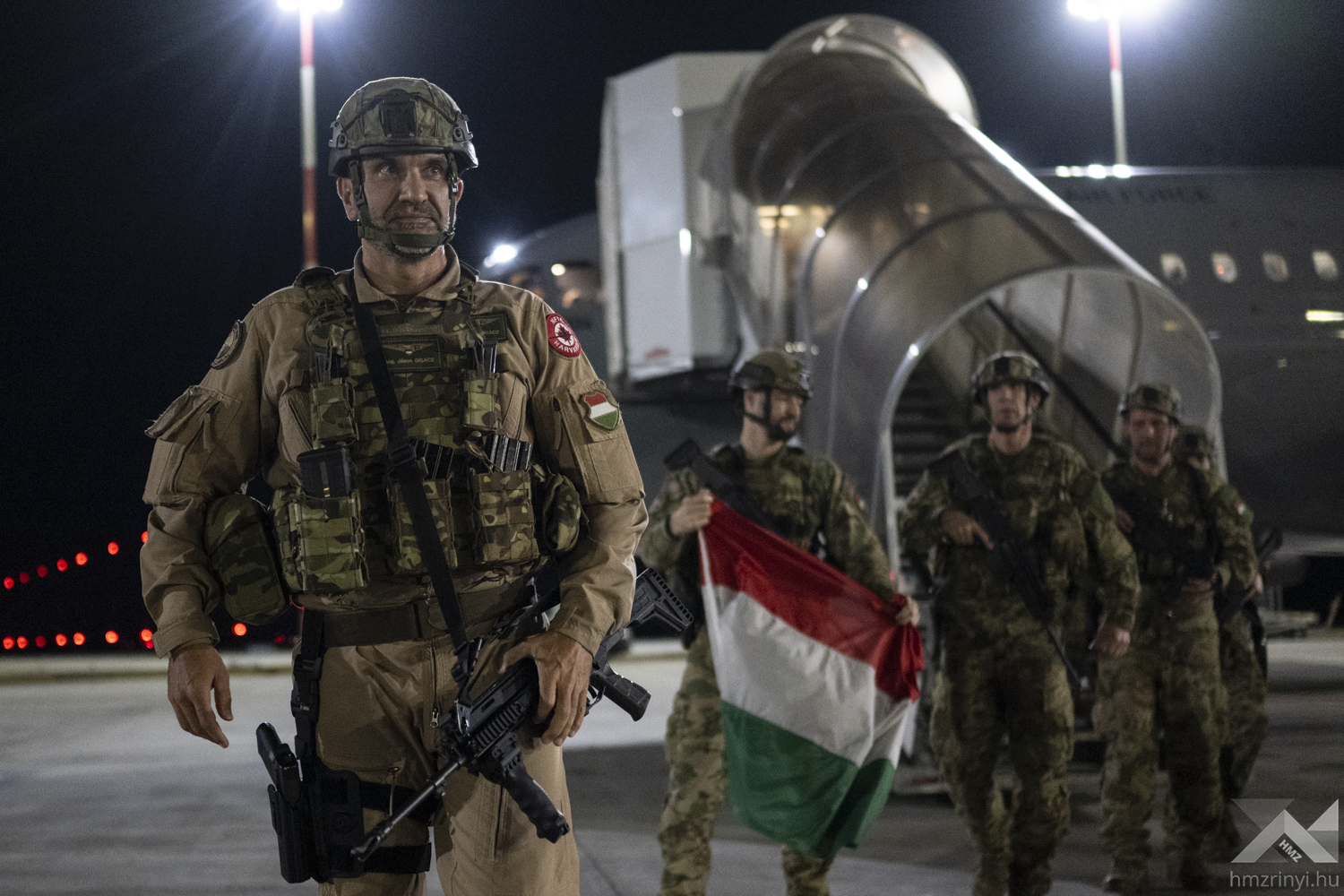
Hungarian soldiers returning home from Iraq. Source: honvedelem.hu
Could the Islamic State Return?
It is a legitimate question to ask whether there is a threat of a repeat of the chaos that followed 2011 or the ill-fated 2021 withdrawal from Afghanistan. As for the Islamic State, according to a U.S. military intelligence assessment from last year, the terrorist organization has been weakened, its capabilities are limited, and it can be kept in check through sustained military pressure. In their report, they added that counterterrorism operations had been stepped up starting in the summer of 2024 to prevent extremists from exploiting the redeployment of U.S. forces and the fall of the Assad regime in Syria. As part of this effort, they eliminated, among others, the Islamic State commander responsible for global operations.
Their assessment is supported by the sharp decline in the number of terrorist attacks. Last year, a total of 12 terrorist attacks were recorded in Iraq, claiming five lives and leaving 19 people wounded.
The chart can be accessed here: https://infogram.com/number-of-terror-attacks-in-iraq-1hnp27eg3oj9n4g
Militias Armed
Various militias, as well as Iranian influence, could pose a serious challenge. As in many Middle Eastern countries, the problem in Iraq is that the state does not have a monopoly on the use of force. Alongside the Iraqi army, there is also the Popular Mobilization Forces: an umbrella organization comprising more than sixty factions and at least 220,000 members, which was formed in 2014 to fight the Islamic State. Officially, they operate under the control of the current government; in reality, however, many of their members— —act independently and have strong ties to Iran. Iraqi Kurdistan, as an autonomous region, also maintains its own security forces. The now-famous Peshmerga played a major role in defeating the terrorist organization. In addition to these, there are countless militias and self-organized armed groups of varying sizes throughout the country. According to estimates by the Iraqi Ministry of the Interior, there may be at least six million weapons in the country.
Baghdad has passed a law to regulate them, under which non-state organizations are required to lay down their arms by the September 30 deadline—that is, in parallel with the U.S. withdrawal. Moreover, this involves not only small arms but also medium-range missiles, drones, and even heavy weapons. While some militias have shown openness to this, others have rejected the idea. It is also unclear how they could be forced to lay down their arms, or how it would be verified that they have indeed surrendered all their weapons. As the deadline approaches, the set date has recently come to be viewed more as the start of the process, and instead of complete disarmament, the focus has shifted to the re-regulation of armaments. In fact, according to Baghdad-based national security adviser Qasim al-Abudi, there is no deadline at all. According to The New York Times, Prime Minister Ali al-Zaidi’s plan consists of three steps:
- A 90-day grace period would begin, during which the militias would refrain from all attacks, and in return, the United States would not target them.
- By June 30, 2027, all militias must lay down their arms or join the Popular Mobilization Forces.
- Those who refuse to do so will become outlaws.
Iran Could Fill the Vacuum
Iraqi groups allied with Iran have repeatedly attacked U.S. bases in recent months. However, the threat will not disappear with the U.S. withdrawal. In early September, a drone strike was launched from Iraq against an oil pipeline running through western Saudi Arabia. There is therefore concern that Iran, which has long been influential, will move to fill the power vacuum.
The figure can be found here: https://infogram.com/gdp-change-in-iraq-1h984wv73qr3d2p
Moreover, the Baghdad leadership is facing this challenge at a difficult economic juncture. Iraq derived 90 percent of its revenue from crude oil sales; before the outbreak of the Iran-Iraq War, it produced more than four million barrels per day, of which 3.4 million barrels were exported, mostly through the Strait of Hormuz. After the strait was closed, exports plummeted, falling to 1.35 million barrels per day in July. Thanks to new routes and an exemption granted by Iran, exports in August had already risen to 2.3 million barrels per day, but they still fall far short of February’s levels. According to Baghdad’s estimates, the country has already lost at least $60 billion due to the conflict with Iran.
And along with the American troops, it seems that American money is also leaving. According to press reports, military and humanitarian aid to Iraq is set to be slashed significantly in fiscal year 2027.

Foreign policy expert, journalist, press officer. He was a foreign policy journalist and editor for fourteen years, mainly at Magyar Nemzet. He specializes in the Middle East and North Africa. As a journalist, he has visited several countries and conflict zones in the region. He has reported from Israel and Palestine, Lebanon, Iraq, Turkey, Jordan, and Saudi Arabia, but he has also visited Ukraine, Nagorno-Karabak, and Cyprus.


